
Will The Trust Last?
A what-if analysis dashboard and AI knowledge platform for complex trust planning.
Overview
A Singapore trustee company needed a better way to assess whether a proposed trust could realistically meet its obligations before the trust was formally established.
We built a client-facing what-if analysis dashboard that allowed professional teams to model trust scenarios, test alternatives, and identify funding or liquidity risks early.
Over time, the same foundation can be extended with AI and knowledge management to support better decisions, surface relevant patterns, and preserve institutional knowledge across similar cases.
The Client
The client was a Singapore trustee company involved in the establishment and administration of private trusts.
Its work sat within a broader estate-planning process that could involve estate planners, lawyers, financial advisers, insurance advisers, investment specialists, tax professionals, and professional trustees.
Each party brought a different perspective, but the final trust still had to work as one coherent and sustainable plan.
The Challenge
The core question was simple: would the trust last?
A proposed trust might need to support a spouse for life, fund education, cover healthcare costs, maintain a property, support a dependant, and make future distributions to beneficiaries.
Each obligation might appear manageable on its own. The challenge emerged when all of them had to be tested together across time, under changing conditions, with different assumptions about returns, inflation, liquidity, and the duration of support.
The Solution
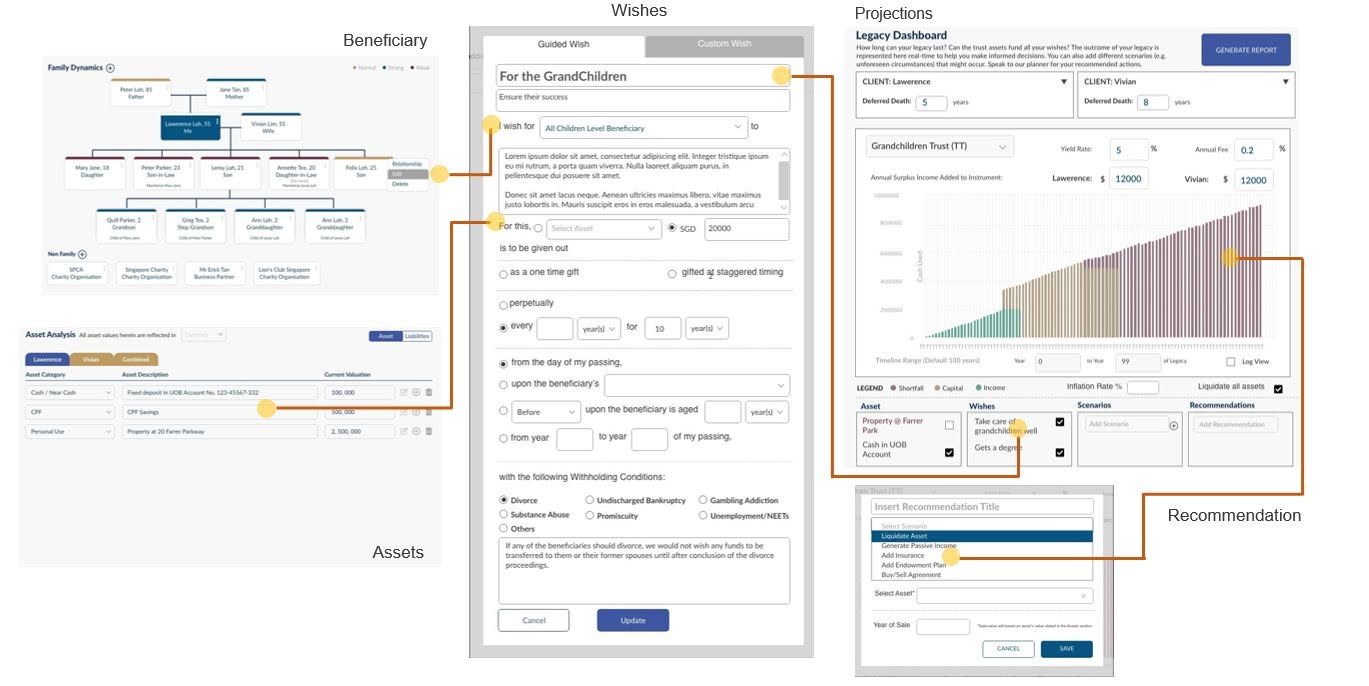
We developed a what-if analysis dashboard that converted trust instructions into a time-based financial model.
The platform allowed the trustee company, estate planner, lawyer, and financial adviser to review assumptions together and test how the trust would perform under different scenarios.
Users could model capital, liquid assets, property, insurance proceeds, expected returns, inflation, recurring payments, education costs, medical expenses, property-related obligations, one-off distributions, and the timing of each obligation.
How the Dashboard Worked
The dashboard did not simply show a projected final balance.
It tested whether sufficient funds and liquidity would be available when each obligation actually became due.
This gave the professional team a clearer view of whether the proposed trust could sustain every intended commitment across the full planning perio
What the Dashboard Revealed
The dashboard helped the team identify:
-
Whether the trust could fulfil all proposed obligations.
-
The first period in which the trust might become underfunded.
-
The lowest projected balance over the trust’s lifetime.
-
Which obligations created the greatest strain.
-
Whether the trust had enough liquidity, not just enough total value.
-
How sensitive the outcome was to changes in assumptions.
Making the Scenario Visible
A trust can appear well funded on paper and still face problems in practice.
For example, a trust may contain valuable property, long-term investments, and insurance proceeds, yet still struggle to fund recurring obligations if liquidity is weak or several major payments fall within the same period.
The dashboard made these hidden pressures visible by allowing the team to test the trust under alternative scenarios instead of relying only on static documents or spreadsheets.
Scenarios the Team Could Test
The professional team could explore questions such as:
-
What happens if investment returns remain below expectations for several years?
-
What happens if inflation raises the cost of living, healthcare, or property maintenance faster than expected?
-
What happens if a spouse or dependant requires support for longer than planned?
-
What happens if much of the trust is held in illiquid assets such as property?
-
What happens if several major obligations overlap during the same period?
-
What happens if a large distribution is needed during a market downturn?
Supporting Better Professional Decisions
The dashboard did not replace the trustee, lawyer, estate planner, or financial adviser. It gave them a shared decision-support model.
The estate planner could test whether the intended legacy remained sustainable. The lawyer could identify provisions that might need more flexibility. The financial adviser could evaluate whether more insurance, more liquidity, or a different income structure was needed. The trustee company could assess whether the proposed trust was realistic to administer over time.
Alternative Approaches the Team Could Review
Where a proposed trust became unsustainable, the team could test practical alternatives such as:
-
Increasing the assets transferred into the trust.
-
Purchasing additional insurance.
-
Reducing or delaying discretionary distributions.
-
Retaining a larger liquidity reserve.
-
Using income-producing assets to support recurring obligations.
-
Matching future liabilities with assets maturing near required dates.
-
Giving the trustee greater discretion to respond to future circumstances.
The Outcome
The solution created a more structured pre-establishment review process.
Instead of reviewing legal provisions, insurance arrangements, investment assumptions, and beneficiary obligations independently, the professional team could examine the trust as one interconnected scenario.
This changed the conversation from “these are the distributions the client wants” to “can these distributions be sustained, and what should be adjusted before the trust is established?”
Extending the Platform with Artificial Intelligence
The original solution was built on deterministic financial modelling, and that foundation remains essential.
Trust planning needs to be explainable, repeatable, and auditable. Artificial intelligence should not replace the financial model or make legal, trustee, or investment decisions on its own.
Instead, AI can add a knowledge and interpretation layer around the dashboard.
nline or in the module Content settings. You can also style every aspect of this content in the module Design settings and even apply custom CSS to this text in the module Advanced settings.
Not sure where AI fits in your business?
Many organisations know they need to improve decision support, knowledge management, and internal processes, but it is not always clear where to start. We’re happy to conduct an exploratory two-hour meeting and provide a complimentary AI readiness and opportunity report tailored to your business.

Effendi Baba
Tech Solutions
Effendi has been in IT for 25 years and is passionate about how data can be used to support decision making through data modelling, visualisation, and algorithms. He has worked with multiple partners and clients and, as such, has in-depth knowledge on facilitating the development and identifying key tech solutions that can address business needs.
In his free time, enjoys cycling and photography. He is actively involved In a social group to support the less-privileged families and is a member of a Toastmaster’s club.
Recent Comments